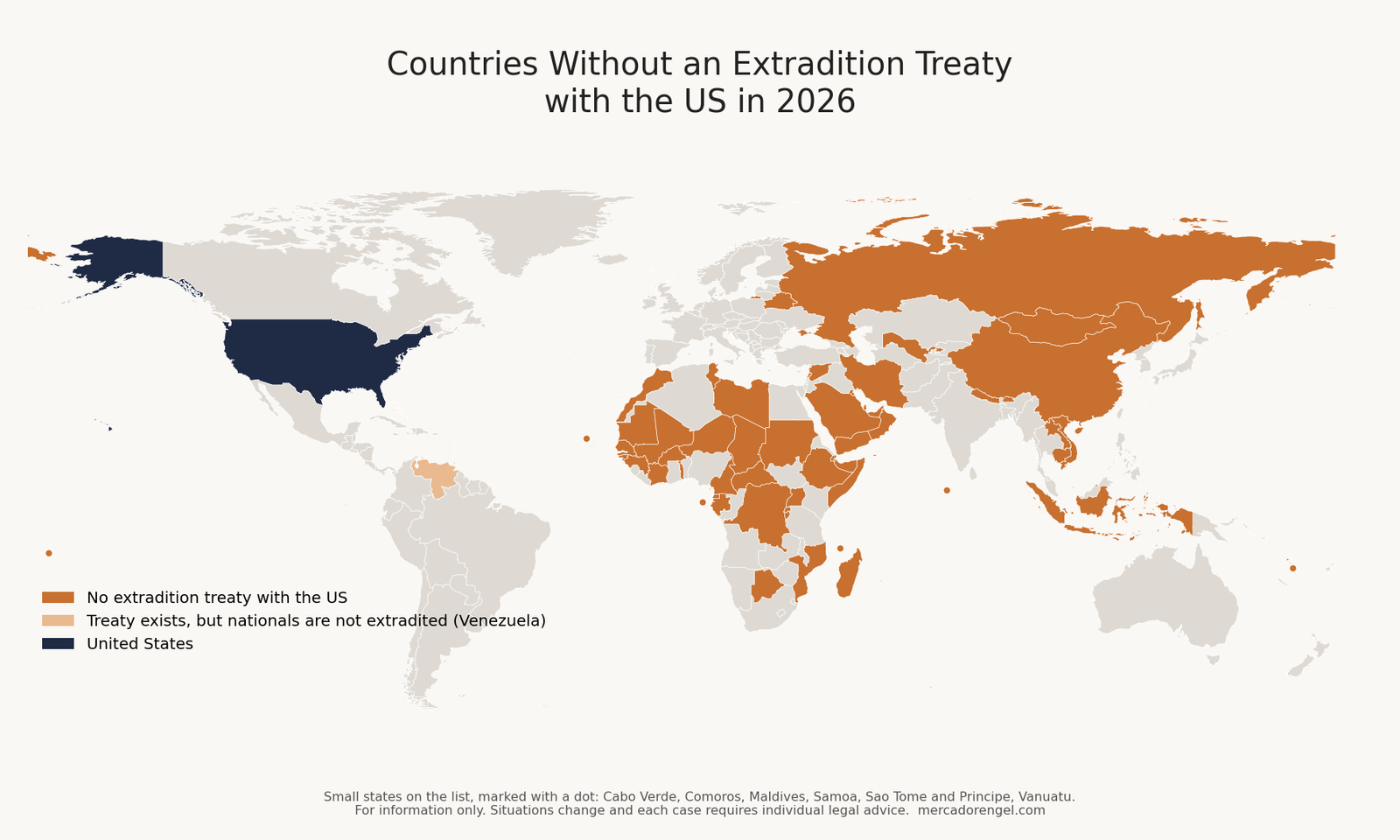
Countries without extradition to the US is one of the most searched questions in international criminal law. This article gives an updated 2026 list of countries that do not have an extradition treaty in force with the United States, together with the legal caveats that anyone reading such a list should understand.
The key point comes first: the absence of an extradition treaty does not mean legal immunity. It does not guarantee that a person cannot be handed over to US authorities by other legal means.
What does it mean when a country has no extradition treaty with the US?
An extradition treaty is a bilateral agreement under which two countries commit to surrender people wanted for criminal offences. Without a treaty, the United States cannot formally demand that a person be surrendered. Other routes can still exist, such as deportation or expulsion under immigration law, surrender agreed case by case, or arrest while travelling through a third country that does have a treaty with the US.
Many countries without an extradition treaty also have mutual legal assistance agreements, which allow the exchange of evidence and information with US prosecutors even when formal extradition is not available.
List of countries without extradition to the US (2026 update)
The following countries do not have a general extradition treaty in force with the United States:
- Belarus
- Bhutan
- Botswana
- Brunei
- Burkina Faso
- Burundi
- Cambodia
- Cameroon
- Cape Verde
- Central African Republic
- Chad
- China
- Comoros
- Democratic Republic of the Congo
- Djibouti
- Equatorial Guinea
- Ethiopia
- Gabon
- Guinea
- Guinea-Bissau
- Indonesia
- Iran
- Ivory Coast
- Kuwait
- Laos
- Lebanon
- Libya
- Madagascar
- Maldives
- Mali
- Mauritania
- Mongolia
- Morocco
- Mozambique
- Nepal
- Niger
- Oman
- Qatar
- Russia
- Rwanda
- Samoa
- Sao Tome and Principe
- Saudi Arabia
- Senegal
- Somalia
- Sudan
- Syria
- Togo
- Tunisia
- Uganda
- United Arab Emirates
- Uzbekistan
- Vanuatu
- Vietnam
- Yemen
Venezuela is a special case: a 1922 extradition treaty with the United States exists, but the Venezuelan Constitution prohibits the extradition of Venezuelan nationals, and in practice cooperation is very limited.
Countries often listed by mistake
Several countries appear on many online lists but do have extradition treaties in force with the United States: Albania, Belize, Canada, Honduras, Jordan and the Philippines. Canada may require assurances that the death penalty will not be sought, and Honduras has extradited its own nationals to the US since a constitutional reform in 2012.
Important warnings about countries without extradition
The legal position can change at any time. Countries sign new treaties, amend existing ones, or cooperate on a case by case basis. In addition:
- The absence of a treaty does not prevent an international arrest.
- Interpol can issue Red Notices that are acted on in many countries.
- Some countries surrender people through deportation or other administrative procedures.
- Travelling through or stopping in a third country can lead to arrest and extradition from that country.
- US charges and warrants do not expire simply because a person is abroad.
For this reason, making legal decisions based only on a list of countries without extradition can be extremely risky. Official information on US treaties is published by the US Department of Justice and the US Department of State.
Legal advice on extradition and international criminal defense
Mercado & Rengel advises clients on extradition, Interpol Red Notices, international judicial cooperation and cross-border criminal defense. Our attorneys are admitted in the United States and in Spain, which allows us to coordinate a federal criminal defense in the United States with proceedings in Spain and other jurisdictions.
Every case must be analyzed individually, taking into account nationality, residence, the type of charges and the jurisdictions involved.
Conclusion
The list of countries without extradition to the US in 2026 is a reference, not a legal guarantee. If an international criminal matter may affect you or a family member, it is essential to obtain specialized legal advice before taking any decision. You can contact our firm for a confidential consultation from the United States, Spain or anywhere in the world. We also take enquiries by WhatsApp and Telegram at +34 627 29 89 37.
A Spanish version of this article is available: Países sin extradición a EE.UU. en 2026.
This article is for information only and does not constitute legal advice. Every legal situation is different and must be analyzed individually by a qualified attorney.